Saturday, May 5, 2007

Possible Side Effects

#38
Title: Possible Side Effects
Author: Augusten Burroughs
Publisher: St. Martin's Press
Year: 2006
Genre: Essay/memoir
291 pages

An enjoyable enough collection of essays by the author of Running with Scissors and Dry. None of these pieces appears to have been published in a magazine before this anthology, and editing may have helped some of them. The quality varies, with many pieces relying on a sort of weak rim-shot punchline. Some pieces read like out-takes from Running with Scissors. As compared to both Dry andMagical Thinking, the "Augusten" narrator is not as snippy and cruel in this collection. His own vulnerability and anxiety are more on display, and though the constant reitterations of "I'm an alcoholic" are wearing, they are at least accurate and about Augusten's appraisal of himself, not about the failings of others.

Tuesday, May 1, 2007

Pendragon: The Merchant of Death

#36
Title: Pendragon: The Merchant of Death
Author: D. J. McHale
Publisher: Aladdin
Year: 2002
Genre: Young adult fantasy
375 pages

I'm sure that there is a way to re-sequence LiveJournal entries but I'm going to waste my time on other things. This book was #36.

There are a number of books entitled "Pendragon" out there, including Lawland's Pendragon Cycle. You'd do best to search for this series by the name of each installment.

The Merchant of Death is the first in the series and sets the grounds for the rest of the series: Bobby Pendragon appears to be a typical popular young teenager, but discovers in a Gaiman-esque scene in an abandoned subway station that he is a Traveler, a sort of interworld, intertemporal good-guy who has a role in the battle between good and evil. This premise is okay and generally well-executed. The device of having Bobby writing to his friends on magical parchment also works reasonably well.

The major problems with this first volume are the overuse of artificial-sounding teenager language in the narration, the formulaic feel of the plot, and implausible worldbuilding that decreases suspension of disbelief. To give two examples of the latter problem, one more throwaway and one more crucial: One of Bobby's earliest observations of Denduron is that it has three suns, which set simultaneously in three quadrants of the sky. Other than a chance convergence I don't see how this is possible. It has no relevance to the plot, so its only actual function is to irritate the reader. More critically, Bobby and his Uncle Press endure a dangerous and harmful journey from the subway to Denduron via a flume that deposits them atop a snowy mountain surrounded by evil creatures called quigs. Later it is revealed that there is a second flume, much more convenient to the village and with no mention of quigs. Apparently Uncle Press didn't choose this flume solely because the author needed Bobby and Press to be separated. This is poor plotting and not compelling.

I don't mean to be overly critical. This series is clearly beach reading, not enduring literature. It's entertaining enough, and judging by the reviews online, children enjoy it even when critics don't. The next few volumes should show whether this is a picaresque series in which a world is saved per volume, or whether a larger plot unfolds.

Friday, April 13, 2007

The Wisdom of Harry Potter: What Our Favorite Hero Teaches Us about Moral Choices

#35
Title: The Wisdom of Harry Potter: What Our Favorite Hero Teaches Us about Moral Choices

Author: Edmund M. Kern
Publisher: Prometheus Books
Year: 2003
Genre: Philosophy/Literary criticism
296 pages

Kern asserts that Harry Potter is a neo-Stoic (or perhaps neo-Stoic-in-training). I'm not in a position to evaluate this assertion, though it seems to me that Kern has some trouble supporting it when it comes to both Harry's obstinacy and his passionate nature--Radcliffe's acting notwithstanding, the Harry of the books is very emotional--and the value Dumbledore places on love. I agree that Harry is beingh trained in constancy, at least.

The more enjoyable sections of the book range more broadly and include examinations of rule-following and rule-breaking, fate versus free will, and Harry Potter as Christian all;egory versus demonic recruitment tool (Kerns's answer: It's neither). I thought Kerns might have done a better job of addressing some of the Marxist critiques of the HP series, as well as more thoughtfully exploring the tension between the world of HP as reinscribing versus satirizing normative cultural values, but hey, a writer can't take on everything. Similarly, I would enjoy reading about the differneces between Stoic and Buddhist interpretations of the series.

Though I have smaller issues I'd enjoy discussing (such as Harry's use of a forbidden curse in OOTP), I'm more interested that my broader moral/ethical concern was not particularly treated, or even identified, by this volume. Though Kern pays some attention to rule-breaking, he does not tackle the systematic breaking of rules that occurs on behalf of promoting Harry as a hero or savior. Again and again, Harry's transgressions are not punished; they are often rewarded; and those in power transgress in his favor, whether evil (Barty Crouch) or good (Professor McGonagall). Harry is rather relentlessly trained to ignore or subvert rules, and one must ask, to what end? The answer, to be able to save everyone, suggests both that the ends justify the means, and ignore the question of what is good for Harry. This question finds one answer in Ender's Game, and it remains to be seen what Harry's status and self-evaluation are post-apocalypse. 

Thursday, April 12, 2007

The Unwanted: A Memoir of Childhood

#34
Title: The Unwanted: A Memoir of Childhood
Author: Kien Nguyen
Publisher: Back Bay
Year: 2001/2002
Genre: Memoir
343 pages
+ Viscerally disturbing and well-told
- A bit more interiority would be interesting, though perhaps neither culturally appropriate nor an accurate reflection of the author's experience

A wrenching narrative of an Amerasian boy's life in post-1975 Vietnam. Kien Nguyen's mother was a banker with two half-white children when Saigon fell to the Northern communists. The family suffered on several accounts: Generally, as South Vietnamese who were suspected of not supporting the North, and hence were presumed to be allied with the U.S.-backed puppet government; as obvious capitalists; as a mixed-ethnicity family; and because Kien's mother had not married her children's fathers.

The book is an almost unrelentingly depressing and horrifying account of poverty, oppression, and discrimination in post-war Vietnam. Though flat at times (like many war narratives by then-children), it was sufficiently disturbing that I had to take breaks while reading. Ultimately, after many beatings, a rape by his mother's ex-boyfriend, starvation, thwarted escapes, and prison, Kien has a chance to leave Vietnam, but first perpetuates the cycle of violence and oppression.

A good companion piece to Truong Nhu Tang's A Viet Cong Memoir: An Inside Account of the Vietnam War and Its Aftermath and Andrew X. Pham's Catfish and Mandala: A Two-Wheeled Voyage Through the Landscape and Memory of Vietnam (I'll be re-reading Pham in the next few months, so watch for a review). As it turns out, Nguyen's first novel, The Tapestries, has been sitting in my stack of books to read as well.

Tuesday, April 10, 2007

The Violet Keystone (The Seventh Tower, #6)

#33
Title: The Violet Keystone (The Seventh Tower, #6)
Author: Garth Nix 
Publisher: Scholastic
Year: 2001
233 pages 


+ Good plotting, satisfying series conclusion
- Some trouble with zip, continuity

The last in the series. A fine conclusion to a generally well-conceived and well-executed children's fantasy series. It's still a little puzzling why a series called "the Seventh Tower" has only six books, but I will live with the mystery. In this concluding volume, Tal and Milla again converge, both symbolically as each learns how to use the violet keystone and proximately as their paths converge. The Freefolk Crow adds a nice unknown element, and the sequence of revelations over the last few books here reaches its logical conclusion.

Though I enjoyed this book and found it satisfying, there were several points I wish had been more fully explored--how the Forgetting was first broken, for example, and the implications of the present conflict for relations between Aenir and Chosen. The shutdown of the Veil and several other points that ought to have been climactic were disappointingly brief, under-emphatic, and vague. In addition, this book had several typos and a couple of minor continuity problems that suggest a rush to print. Still, this was an enjoyable and well-written series and I look forward to more Garth Nix.


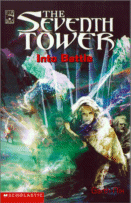
The Seventh Tower: Into Battle

Author: Garth Nix
Publisher: Scholastic
Year: 2001
Genre: Children's Fantasy
201 pages
+ Sustained action rising toward a crescendo
- A little more emotional depth would better match the characters' growing maturity
The fifth in the series. Tal must go to Aenir to enlist the Empress's help, and Milla must lead the Icecarls into the Chosen enclave. The Freefolk, an unknown quantity, nicely complicate their missions and goals.

The action generally alternates between Tal and Milla's stories as each races to complete daunting tasks. The pace is a bit more frenetic and chapters often close on a cliffhanger. Both protagonists come into their own more fully, and the association with the Freefolk suggests what I hope will happen in Harry Potter and the Deathly Hallows, which is that privileged protagonists must empathize with and promote justice for their society's underclass.

Sunday, April 1, 2007

The Seventh Tower: Above the Veil


#31
Title: The Seventh Tower: Above the Veil
Author: Garth Nix
Publisher: Scholastic
Year: 2001
Genre: Children's Fantasy
248 pages
+ Continued revelations about the world of the story, good character interactions
- No substantive critiques
The fourth in the series. Tal and Milla continue their uneasy alliance. Tal, still hoping to return everything to normal, sometimes misses or does not ponder information that could be highly relevant. Milla, though in some ways initially more rigid, sees change and the implications of new knowledge more clearly. They respectively illustrate Piaget's notions of assimilation and accommodation.

In the previous volume, the reader learned more about Aenir, the world from which the Shadowspirits come. In book 4, the Underfolk of the Castle have their chance to become more vivid and personal. In this way, the series allows the reader to follow Tal's growing awareness of other people and the broader world as his skilfulness with light magic develops. One hopes that he will awaken from his youthful egocentrism. Milla undergoes a different sort of transformation after she returns to her people to deliver her news, then give herself to the Ice.