Monday, February 26, 2007

Charlie Bone and the Castle of Mirrors

#24
Title: Charlie Bone and the Castle of Mirrors Author: Jenny Nimmo
Publisher
: Scholastic
Year: 2005
Genre: Children/Fantasy
410 pages
+ Better character development (for some characters), somewhat better plot construction
- Most characters are still flat, most adults are still ineffective, the overall story arc is unclear and meanders

In some ways this installment is an improvement over the previous three in this series. Nimmo actually seems to have anticipated aspects of the plot earlier in the series, and to be looking ahead to future volumes. However, it is still rather disappointing. Characters who are no longer needed for their one plot point simply disappear, objects of great attention in one book never reappear, and it is still the case that any new information about a character is quickly shown to be a vital plot point. Charlie Bone and the Invisible Boyended with an incipient visit to Sparkling Castle. However, the castle, Ollie, and Mr. Boldova are not even discussed in the present volume. Christopher Crowquill comes out of nowhere and, his utility outlived, he disappears from the action.

Inconsistencies and discontinuities abound. For example, we learn that the endowed can usually identify each other, but Cook has never been identified by the Bloors. A character whose endowment flowers in this volume is similarly not identified by the other endowed. We learn late in the book that a shapeshifter has the people he is impersonating held captive. There is some implication that this is not just to keep them out of the way, but to "borrow...the mind" of the person. Should we then suppose that Yolanda had a little blonde girl locked away somewhere earlier in the series? Charlie now speaks enough Welsh to command the wand, though we haven't seen him study the list Uncle Patton gave him. An evidently stupid endowed child puts on a cape, even knowing that various poisoned-clothes makers are about. There is much to-do about the child's rescue and how important it was to circumvent the staff of Bloor's; later, however, said child is recouperating in the Academy's infirmary, presumably vulnerable to the Bloors' influence, but no one cares about this. Why do the prisoner's captors sequester him at the castle? It seems pretty labor- and capital-intensive to do so. Please don't get me started on the question of why a few rottweilers would disrupt Pets' Cafe, but the presence of multiple other dogs, cats, gerbils, a giant blue snake, birds, rats, ducks, etc. does not.

Charlie and some of the other endowed children remain at Bloor's Academy to keep the balance. Other endowed seem not to have this compulsion, either as children or adults. I'm astounded that endowed parents who are aware of the ongoing struggle of good vs. evil would permit their children to attend Bloor's without adequate monitoring and safeguards; I am also astounded that they would not descend on Bloor's en masse to tip the balance to the side of good. Indeed, the endowed seem for the most part to be remarkably disorganized.

The characters' lack of curiosity troubles me. Asa used to dress up badly and follow people; he no longer does so, but no one wonders why. Charlie's wand turns into a moth, but no one seems to find this interesting or noteworthy. The adults remain generally inadequate; perhaps they are as unimaginative as the children.

Troublingly from a humanitarian perspective, Uncle Paton has received an inheritance, which he spends on gourmet food. Given our understanding that Amy Bone is under Grizelda's thumb because she lacks the economic resources to have her own house, Paton's behavior seems remarkably insensitive. In addition, there's something that rings a little racist to me in Lysander's repeated reference to his ancestors as "my African ancestors." If I were an endowed person from my own ethnic background, would it be necessary for me to refer again and again to invoking the spirits of "my Jewish ancestors"? "Don't worry, Charlie--I'll call upon the powers of my Jewish ancestors"? "Don't worry, Lysander--I'll call upon the powers of my WASP ancestors"?

Poor editing dogs this series. This volume again reprints the introductory page about the Red King and his Time Twister, which has no bearing on the events in this book. The family named de Grey was referred to in the publisher's promotional materials as "O'Gre." While O'Gre makes more sense than de Grey, it was apparently changed after promo materials went to booksellers and others, lending confusion to the enterprise. Finally, and I hope that this is not too much of a spoiler, the Castle of Mirrors has relatively little to do with the book, and is an inaccurate title for that reason.

Sunday, February 25, 2007

Not Even Wrong: A Father’s Journey into the Lost History of Autism


#23
Title: Not Even Wrong: A Father’s Journey into the Lost History of Autism 
Author: Paul Collins
Publisher: 
Bloomsbury
Year: 2004
Genre: Memoir/Psychology
245 pages
+ Informative, emotional, sophisticated, and ultimately optimistic
- No substantive concerns

This is such a lovely book that I wish that you would read it so we can talk about it. Paul Collins and his wife learn that their son is autistic (probably in the Asperger's range, though he doesn't say). Collins evokes a parent's vulnerability and tenderness in relation to his son. The story of their son Morgan and their relationship with him is interwoven with historical material on feral children, savants, artists, scientists, and other probable autists. I am reasonably conversant with the literature on autism spectrum disorders, but I learned several new facts from Collins and enjoyed his restrained excoriaton of Bettelheim.

Collins is a good writer and I hope to read his earlier Banvard's Folly: Thirteen Tales of People Who Didn't Change the World soon. I enjoyed the juxtapositions of family and historical tales, particularly since these conjunctions lend a pattern-seeking layer to the reader's experience. I would have liked to know more about Morgan's mother, Jennifer. She is the most elusive character in Morgan's story.

Self-Made Man: One Woman’s Year Disguised as a Man


#22
Title: Self-Made Man: One Woman’s Year Disguised as a Man 
Author: Norah Vincent
Publisher: Penguin
Year: 2006
Genre: Autobiography/Social Science
296 pages
+ Interesting sociological adventure and engaging first-person account
- Tiresome gender stereotypes, use of deceptive techniques

In the tradition of John Howard Griffin's Black Like Me and Barbara Ehrenreich's Nickel and Dimed: On (Not) Getting By in America, Norah Vincent disguised herself as a man and, for a year and a half, attempted to learn how men behave in their own company. While this is an intersting pursuit, and Vincent is not a bad writer, I was nonetheless disappointed by the fundamental triviality of her conclusions. Vincent seems to like neither men nor women as a group, and this antipathy is wearing after a while. Yes, she has something of a feminist outlook, but it is neither mature nor complex. Her observations about masculinity and femininity are not particularly nuanced and seem surprisingly naive for an adult. Her reported experiences with men prior to this experiment are scant, and those with women are stereotypical and suggest that women are mean and not to be trusted. Vincent fails to challenge this highly gendered world view; she masquerades as Ned in environments at the extremes of the distribution of stereotypical masculine behavior--a bowling league, anIron John-inspired men's support group and retreat, a door-to-door commission sales job, and a Catholic monastery. I wish that she had included a wider range of settings where men congregate, alone or with women, such as an office job or bookstore. At that, why no gay men's group? Vincent compounds her stereotypes by dating women through web-based services; this is fine, but why not try to meet women through a mutual interest (books, birdwatching, sports, etc.) for a more balanced experience? I can't think much of Vincent's observations about women's neediness when she is overgeneralizing from a very small and specific pool. Disturbingly, she has sex with one of these women. No word on what her girlfriend has to say about this.

I was troubled by Vincent's deceptive techniques, but more troubled in some ways by her urge (and in some cases, she acted on this urge) to reveal herself. She sees it as confessional and perhaps as a way to seek forgiveness for the deception; I experience it as a form of taunting or narcissism disguised as confession.

Be sure to check out both the hardback and paperback covers for several views of Norah and Ned.

Sunday, February 18, 2007

Charlie Bone and the Invisible Boy


#21
Title: Charlie Bone and the Invisible Boy
Author: Jenny Nimmo
Publisher
: Scholastic
Year: 2004
Genre: Children/Fantasy
408 pages
+ Some character development and interesting plot twists
- Generally emotionally superficial; action somewhat illogical and inconsequential

This is the third book in the Children of the Red King/Charlie Bone series. I'm ambivalent about this volume. On the positive side, we learn more about Charlie's history, the Bloors, and the legacy of the Red King. While many of the images and events, such as talking to a giant magical snake, resonate heavily with Harry Potter, it's also true that there are a limited number of motifs from which to choose when drawing on mythic imagery. Skarpo's reappearance has some unexpected twists, and Billie's character is fleshed out and made more complex.

On the down side, the book suffers from the flaws of the previous two in the series, which are in my reviews so I won't reitterate most of them here. While there is some effort at character development, the children all seem flat and the adults even moreso. The adults are cruel yet highly ineffective, raising the question of why they are still in charge. The plot is often illogical (for example, Ollie's explanation of why he never left the Academy; Mr. Bodova's sudden return to normalcy) or inexplicable (why Ollie never contacted his family) or insufficiently prepared for (Venetia suddenly is described as someone who makes magical clothes). I understand why Ollie might not want to be invisble, but it seems like an invisible boy could be very useful in the battle against the Bloors and the wicked endowed. As was the case in the second book, plot elements are discarded after they are nominally resolved. This lends a picaresque air to the enterprise and works against finding any satisfaction in a long story arc. Events are disconnected from each other and thus largely inconsequential. What of the knight and his casket from the first book? What of the dagger the villains hoped Charlie would pick up in the second book? What happened to Henry? While I hope that these questions are ultimately answered, I don't see much evidence that they will be. I think it is unlikely that the many dangling elements will be resolved by the end of the series.

Oddly, multiple official reviews of this book repeat the statement that Mr. Boldova is a new art teacher. However, he was introduced in the previous book. Also oddly, the book begins with a statement that the Red King's time twister can be dangerous and unpredictable; however, this has nothing to do with this volume, and appears to have been accidentally transposed from the second book. This contributes to the impression that these books are under-edited.

Saturday, February 17, 2007

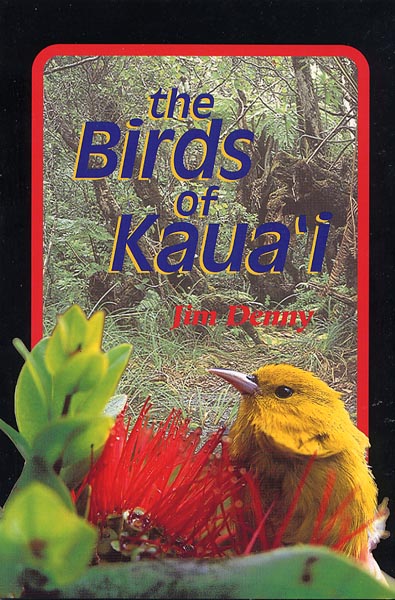
The Birds of Kaua'i


#20
Title: 
 The Birds of Kaua'i
Author: Jim Denny
Publisher: 
University of Hawaii Press
Year: 1999
Genre: Natural history
120 pages
+ Large photos of birds in their habitats; useful information about birds
- Extinct and very rare birds mixed in with more likely sightings

After recently reading Phoebe Snetsinger's Birding on Borrowed Time, it was fun to see Denny acknowledging her son,Tom Snetsinger, an avian field researcher in Hawaii. This book is not a field guide, but is useful for learning about Kaua'i's birds' habitats, behaviors, and sometimes calls. The inclusion of some historical and environmental information is welcome and these pages are easy to read and engaging. The bird photos are larger than in many field guides and show the birds in more naturalistic poses. More on markings and differentiation between birds of similar appearance would be useful. The birds are presented by habitat, which is useful, but very rarely seen and extinct birds are intermingled with observable birds, which is distracting. This is true of the included bird checklist as well.

Many birders recommend H. Douglas Pratt et al.'s A Field Guide to the Birds of Hawaii and the Tropical Pacific, but for us bird dilettantes, Pratt and Jeffrey's A Pocket Guide to Hawai'i's Birds is probably sufficient when paired with The Birds of Kaua'i for island-specific focus.

Men and Cartoons: Stories


Author: Jonathan Lethem
Publisher
: Doubleday
Year: 2004
Genre: Short stories
160 pages
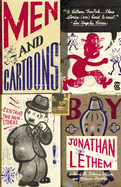
+ Deft characterizations, deadpan delivery of outlandish premises, fun cover art
- There's not much wrong with it. The last story seems weak as an anchor for the collection.

This is my 4th Lethem and the most delightful short story collection I've read recently. Lethem's focus here is on relationships--with oneself, with others--and the failure of communication. In many of the stories, intrusive encounters and unwitting coincidental meetings (with people previously known and unknown) provide the painful and sometimes humiliating impetus for the conclusion, which is often the narrator's awareness that he has disconnected or failed. This sounds grimmer than the collection actually is. Lethem's environments, as always, are fascinating and deceptively easily established; his dialogue is clever and wry without being offputting; his characters seem genuinely surprised or merely bewildered by their own lives. The conflicts that befall them are emotionally universal, yet at the narrative level bizarre. While none of us is likely to encounter the Sylvia Plath Sheep, we are all too familiar with the existential consequences brought on by that encounter. Even when they behave badly, Lethem's protagonists are likeable schlubs, and familiar schlubs at that.
 
A unifying theme present in many of these stories is the comicbook superhero, some of whose avatars are more successful than others. In addition, the collection uses minor images and motifs to bridge the stories. Some are thematic similarities ("The Spray" makes missing objects visible, then in "Planet Big Zero" the narrator comments, "so much of life becomes invisible"); others are more like puns (Toscanini's glasses in "Planet Big Zero" foreshadow "The Glasses").

Though I enjoyed the whole collection as a group, "The Spray" and "Big Planet Zero" were my favorites. "The Glasses" is the most poignant, and the only story that seemed to demonstrate the triumph of connection over isolation, albeit subtlely. "The National Anthem" is the anchor story and the weakest in the collection. It seemed too self-conscious and I was not engaged by it. Perhaps it was too reflective in a collection that otherwise used more eventful narratives. Perhaps it would have been more satisfying if it had reprised the comics motif. Whatever the reason, it is unsatisfying, and the only low point in an otherwise fine and sophisticated collection.

The back cover art on the hardback edition is in the form of the ad pages that used to run in comic books (think "X-Ray Spex!"). Some are blurbs about the stories; some are spoofs of ads ("Raise Fun-Loving AQUA CHIMPS/JUST ADD WATER!/Or mustard or vermouth or Drano or whatever. It's never too early to learn how fleeting love can be...."). You can see it using Amazon's Search Inside feature.

Friday, February 16, 2007

Charlie Bone and the Time Twister


Author: Jenny Nimmo
Publisher
: Scholastic
Year: 2003
Genre: Children/Fantasy
402 pages
+ Likable characters, generally compelling villains
- Multiple plot problems and inconsistencies, very rushed coverage of climactic moments

A disappointing and uneven second book in the Charlie Bone/Children of the Red King series. I will suspend any comments about Henry and the Time Twister until I have read the rest of the books, and I hope that both of these elements prove critical to the overarching plot. On the positive side, we see Charlie's relationships develop, new characters are introduced, and we (and Charlie) gather new information about the Red King and, perhaps, a confrontation between his good and evil progeny.

Unfortunately, bad plot construction, bad editing, or both contribute multiple flaws to this volume. I am willing to suspend disbelief if the world depicted in a novel stays true to its own internal logic. This rule is violated in numerous instances, some small (if the endowed are never expelled, why do they put up with the cruel and capricious rules at Bloor's Academy?), some large (if the Time Twister is unidirectional, the argument about Mrs. Bloor is not compelling). Additional problems are introduced related to what appears to be faulty world-building. Are all of the endowed children morally compelled to attend Bloor's? Then why aren't (or weren't) the other endowed who have not attended Bloor's? If Charlie can "hear" portraits, why doesn't he hear the drawing of the Tollroc?

Worse still, both Charlie and Henry engage in extremely stupid decision-making that has no justification or basis given how Charlie has been described beforehand or how Henry was introduced. Their actions are implausible as well as distancing for the reader, and contribute strongly to the sense that Nimmo did not think this through as well as she might have. Inadequate forethought an characterization appear elsewhere, as Charlie seems to forget that Billy's allegiances are clear and Gabriel has "the famous gerbils" (never named in Book 1 but suddenly needed for the plot in Book 2), to give only two examples. Encounters with both Skarpo and the Red King are brief and underwhelming considering the power they should pack. I can't imagine that a reader would not have known where Charlie's father is by halfway into Midnight for Charlie Bone, and Book 2 does little to advance this aspect of the story.

The timing is off in a sequence involving a freezer; the villains are astonishingly ineffective; Uncle Patton's car would have to have headlights; I could go on naming inconsistencies. Since Midnight for Charlie Bone was much more coherent, I can only hope that Charlie Bone and the Invisible Boy is a more sufficient offering.