Friday, April 13, 2007

The Wisdom of Harry Potter: What Our Favorite Hero Teaches Us about Moral Choices

#35
Title: The Wisdom of Harry Potter: What Our Favorite Hero Teaches Us about Moral Choices

Author: Edmund M. Kern
Publisher: Prometheus Books
Year: 2003
Genre: Philosophy/Literary criticism
296 pages

Kern asserts that Harry Potter is a neo-Stoic (or perhaps neo-Stoic-in-training). I'm not in a position to evaluate this assertion, though it seems to me that Kern has some trouble supporting it when it comes to both Harry's obstinacy and his passionate nature--Radcliffe's acting notwithstanding, the Harry of the books is very emotional--and the value Dumbledore places on love. I agree that Harry is beingh trained in constancy, at least.

The more enjoyable sections of the book range more broadly and include examinations of rule-following and rule-breaking, fate versus free will, and Harry Potter as Christian all;egory versus demonic recruitment tool (Kerns's answer: It's neither). I thought Kerns might have done a better job of addressing some of the Marxist critiques of the HP series, as well as more thoughtfully exploring the tension between the world of HP as reinscribing versus satirizing normative cultural values, but hey, a writer can't take on everything. Similarly, I would enjoy reading about the differneces between Stoic and Buddhist interpretations of the series.

Though I have smaller issues I'd enjoy discussing (such as Harry's use of a forbidden curse in OOTP), I'm more interested that my broader moral/ethical concern was not particularly treated, or even identified, by this volume. Though Kern pays some attention to rule-breaking, he does not tackle the systematic breaking of rules that occurs on behalf of promoting Harry as a hero or savior. Again and again, Harry's transgressions are not punished; they are often rewarded; and those in power transgress in his favor, whether evil (Barty Crouch) or good (Professor McGonagall). Harry is rather relentlessly trained to ignore or subvert rules, and one must ask, to what end? The answer, to be able to save everyone, suggests both that the ends justify the means, and ignore the question of what is good for Harry. This question finds one answer in Ender's Game, and it remains to be seen what Harry's status and self-evaluation are post-apocalypse. 

Thursday, April 12, 2007

The Unwanted: A Memoir of Childhood

#34
Title: The Unwanted: A Memoir of Childhood
Author: Kien Nguyen
Publisher: Back Bay
Year: 2001/2002
Genre: Memoir
343 pages
+ Viscerally disturbing and well-told
- A bit more interiority would be interesting, though perhaps neither culturally appropriate nor an accurate reflection of the author's experience

A wrenching narrative of an Amerasian boy's life in post-1975 Vietnam. Kien Nguyen's mother was a banker with two half-white children when Saigon fell to the Northern communists. The family suffered on several accounts: Generally, as South Vietnamese who were suspected of not supporting the North, and hence were presumed to be allied with the U.S.-backed puppet government; as obvious capitalists; as a mixed-ethnicity family; and because Kien's mother had not married her children's fathers.

The book is an almost unrelentingly depressing and horrifying account of poverty, oppression, and discrimination in post-war Vietnam. Though flat at times (like many war narratives by then-children), it was sufficiently disturbing that I had to take breaks while reading. Ultimately, after many beatings, a rape by his mother's ex-boyfriend, starvation, thwarted escapes, and prison, Kien has a chance to leave Vietnam, but first perpetuates the cycle of violence and oppression.

A good companion piece to Truong Nhu Tang's A Viet Cong Memoir: An Inside Account of the Vietnam War and Its Aftermath and Andrew X. Pham's Catfish and Mandala: A Two-Wheeled Voyage Through the Landscape and Memory of Vietnam (I'll be re-reading Pham in the next few months, so watch for a review). As it turns out, Nguyen's first novel, The Tapestries, has been sitting in my stack of books to read as well.

Tuesday, April 10, 2007

The Violet Keystone (The Seventh Tower, #6)

#33
Title: The Violet Keystone (The Seventh Tower, #6)
Author: Garth Nix 
Publisher: Scholastic
Year: 2001
233 pages 


+ Good plotting, satisfying series conclusion
- Some trouble with zip, continuity

The last in the series. A fine conclusion to a generally well-conceived and well-executed children's fantasy series. It's still a little puzzling why a series called "the Seventh Tower" has only six books, but I will live with the mystery. In this concluding volume, Tal and Milla again converge, both symbolically as each learns how to use the violet keystone and proximately as their paths converge. The Freefolk Crow adds a nice unknown element, and the sequence of revelations over the last few books here reaches its logical conclusion.

Though I enjoyed this book and found it satisfying, there were several points I wish had been more fully explored--how the Forgetting was first broken, for example, and the implications of the present conflict for relations between Aenir and Chosen. The shutdown of the Veil and several other points that ought to have been climactic were disappointingly brief, under-emphatic, and vague. In addition, this book had several typos and a couple of minor continuity problems that suggest a rush to print. Still, this was an enjoyable and well-written series and I look forward to more Garth Nix.


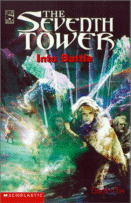
The Seventh Tower: Into Battle

Author: Garth Nix
Publisher: Scholastic
Year: 2001
Genre: Children's Fantasy
201 pages
+ Sustained action rising toward a crescendo
- A little more emotional depth would better match the characters' growing maturity
The fifth in the series. Tal must go to Aenir to enlist the Empress's help, and Milla must lead the Icecarls into the Chosen enclave. The Freefolk, an unknown quantity, nicely complicate their missions and goals.

The action generally alternates between Tal and Milla's stories as each races to complete daunting tasks. The pace is a bit more frenetic and chapters often close on a cliffhanger. Both protagonists come into their own more fully, and the association with the Freefolk suggests what I hope will happen in Harry Potter and the Deathly Hallows, which is that privileged protagonists must empathize with and promote justice for their society's underclass.

Sunday, April 1, 2007

The Seventh Tower: Above the Veil


#31
Title: The Seventh Tower: Above the Veil
Author: Garth Nix
Publisher: Scholastic
Year: 2001
Genre: Children's Fantasy
248 pages
+ Continued revelations about the world of the story, good character interactions
- No substantive critiques
The fourth in the series. Tal and Milla continue their uneasy alliance. Tal, still hoping to return everything to normal, sometimes misses or does not ponder information that could be highly relevant. Milla, though in some ways initially more rigid, sees change and the implications of new knowledge more clearly. They respectively illustrate Piaget's notions of assimilation and accommodation.

In the previous volume, the reader learned more about Aenir, the world from which the Shadowspirits come. In book 4, the Underfolk of the Castle have their chance to become more vivid and personal. In this way, the series allows the reader to follow Tal's growing awareness of other people and the broader world as his skilfulness with light magic develops. One hopes that he will awaken from his youthful egocentrism. Milla undergoes a different sort of transformation after she returns to her people to deliver her news, then give herself to the Ice.

Friday, March 30, 2007

My Detachment: A Memoir

#30
Title: My Detachment: A Memoir
Author: Tracy Kidder
Publisher: Random House
Year: 2005
Genre: Autobiography/Vietnam War
192 pages
+ Well-written and a nice direction for Kidder
- Brief at times, sometimes interpersonally flat

A poignant memoir of the author's service in the Vietnam War. Following Kidder's Mountains beyond Mountains: The Quest of Dr. Paul Farmer, a Man Who Would Cure the World, in which the reader saw much more of Kidder's reactions and vulnerability than in the past, it is personal and poignant. Kidder describes his self-conscious adolescence and rather affected presentation of self as a Harvard undergraduate. Eager to be admired and easily influenced by others, he joins ROTC and completes a 1-year tour in Vietnam. His consciousness of classism and racism emerges over the course of this time but is not well-articulated, which I understand as Kidder's effort to reflect his consciousness at the time. His understanding of sexism is more nascent, though Kidder-as-narrator does note that the novel he wrote after his service was about a man done in by trying to protect a Vietnamese woman from rape.

Kidder depicts himself as an uneasy, sometimes self-loathing, self-absorbed young adult. He quotes from letters in which he lied to familiy and friends, exaggerating the danger he was in, his herosim, and his charity toward imaginary Vietnamese children. His actual war experience appears generally not to have put him at great risk (though certainly the strain of living in a war zone takes its toll).

Though Kidder has a coherent story to tell about his coming of age, he tells a more interesting parallel story about the development of a writer. He quotes excerpts from his novel and letters, showing not only the development of his craft, but also the development of a narrating (and sometimes fantasizing the camera shots) persona, one who is sometimes unreliable. As some reviewers have pointed out, his interest in The Great Gatsby may signal that the reader should take the present narrative with a grain of salt, though I wonder if its possible lack of reliability errs in the opposite direction--Kidder seems awfully hard on his younger self.

The title suggests not only Kidder's unit, but also his lack of attachment at the time, his lack of connection to Vietnam (he seems to have stayed in a fairly small military bubble by choice), and perhaps the act of detaching from the experience from his current vantage. It's a good title. If anything, the narrative is just a little too detached, and I wonder where the immediacy of, for example, fear has gone. Perhaps the narrative replicates what appears to be depression, or reflects the isolation in and out of which he moved. There is more than a whiff of failure about Kidder's command, relationships, and writing, at least in retrospect.

Read with Swofford's Jarhead: A Marine's Chronicle of the Gulf War and Other Battles and Jenning's Mouthful of Rocks: Modern Adventures in the French Foreign Legion to immerse yourself in the boredom of war. Jenning is said by some to be a boastful and unreliable narrator, so these two accounts nicely bracket Kidder's year as an REMF. For musings on men and how masculinity can be used oppressively by other men, pair it with Vincent's Self-Made Man: One Woman's Year Disguised as a Man, which I've reviewed and disliked, but which could be a useful foil for Kidder's account.

Thursday, March 29, 2007

Hawaii's Birds (6th ed.)


#29
Title: Hawaii's Birds (6th ed.)
Author: Hawaii Audubon Society
Publisher: Hawaii Audubon Society
Year: 2005
Genre: Field Guide
141 pages
+ Easier to use than previous edition, better photos and color register
- Some photos omitted from previous edition were helpful for identification, still some disorganization
I've pulled the cover graphic from the Hawaii Audubon site; it shows both sides of the cover. To order, click on the title above, which is linked to the Hawaii Audubon online store.

This new edition is a great improvement over the 5th. Entries cover 141 species and subspecies. Birds are still organized by habitat, but page headers and color coding make finding a bird much quicker, which is useful for field identification. Symbols showing endemic, indigenous, alien, visitor, and endangered species are clearer. The endemic bird list and distribution maps have been updated, as have references and descriptions (for example, this edition notes the split of the African Silverbill [Lonchura cantans] from the Warbling Silverbill [Lonchura malabarica]). Each entry includes 1-2 photos (many of higher quality than in thge previous edition), the common name, Hawaiian name, genus and species (plus subspecies where relevant), distribution, description, voice, and habits. The "voice" and "habits" sections are especially helpful for differentiating between birds of similar habitat and appearance. A collection of island maps in the back provide a quick reference for common birds.

Although the color-coded tabs make the book much more usable, it's still not clear what determined the order in which birds appear within each section. It is the same as in the 5th edition and is not alphabetical by common name, Hawaiian name, or genus; it also is not in order of relative frequency. While I appreciate most of the new photos, and particularly those of juveniles, some omissions are puzzling. For example, the 5th edition had a nice photo of a White-tailed Tropicbird from above, showing the black markings on its wings that help differentiate it from the Red-tailed Tropicbird when it is at a distance and the tail color can't be seen. This was especially useful since viewing opportunities at Kilauea Point and Waimea Canyon are often from overhead and at a distance. The 5th edition also included a facing page photo of an immature Red-tailed Tropicbird, illustrating the description of "heavy black barring on upperparts" (5th ed., p. 16). This photo is omitted from the 6th edition. Thus, there is now a notation of the juvenile Red-tail's "heavy black barring" and the adult White-tail's "black marks on wings and back" but no photo of either to guide the reader. Since the text notes that a third species, the Red-billed Tropicbird, has recently been seen at Kiluea Point, and that it has "heavily barred upperparts," the identification is muddier still for those not already familiar with the three species.

If I were in charge of the the 7th edition, I would organize each section by main color or by most-to-least common, include a photo of an immature bird when this aids differentiation, include a colored notation by each bird identifying the islands on which it is found (to supplement the text and the endemic checklist in the back), and move birds presumed to be extinct or exceptionally rare to a new section.

This field guide is useful for quick identifications of the expected birds; less so for visitors. It has the virtue of large photos and is small enough to carry easily. For more comprehensive coverage, spring the $45 for Pratt et al.'s A Field Guide to the Birds of Hawaii and the Tropical Pacific. Yes, it's woefully out of date (it was last revised in 1987), but it provides illustrations of juveniles and adults of both sexes, side-by-side species, and a broader geographic range. Pratt's newer Enjoying Birds and Other Wildlife in Hawai'i (revised 2002) is light on bird photos but heavy on viewing sites, species lists, and information. It includes military bases and atolls; you can't get there from here but it's still interesting to know. It could be heavier on "other wildlife" (a 4-page sop rather than a real focus; on my last trip I saw butterflies, other insects, an amphibian, a reptile, and a nice big spider that aren't represented here).
Of the 141 birds represented in the Audubon book, we saw 40-41 (one identification still pending) in 4 days this month, one at the airport on O'ahu, the others on Kaua'i at Kilauea Point NWR, Hanalei NWR, Waimea Canyon SP, Koke'e SP, Alaka'i Wilderness and along the Kuhio and Kaumuali'i highways, as well as outside the hotel.

For those who enjoy this game, or who doubt that I actually read field guides straight through, here's what we saw (in order of appearance in the book). A * means a first sighting for me.

Common Name (Hawaiian Name) Genus species subspecies
*Laysan Albatross (Moli) Phoebastria immutablis
Red-tailed Tropicbird (Koa'e 'ula) Phaethon rubricauda melanorhynchosWhite-tailed Tropicbird (Koa'e Kea) Phaethon lepturus dorotheae
Red-footed Booby ('A) Sula sula rubrides
Great Frigatebird ('Iwa) Fregata minor palmerstoniBlack-crowned Night-heron ('Auku'u) Nycticorax nycticorax hoactli
[Hawaiian Duck] (Koloa) Anas wyvillianaHawaiian Coot ('Alae Ke'oke'o) Fulica alai*Common Moorhen [or Hawaiian Gallinule] ('Alae 'Ula) Gallinula chloropus sandvicensisBlack-Necked Stilt [Hawaiian Stilt] (Ae'o) Himantopus mexicanus knudseni*Pacific Golden-Plover (Kolea) Pluvialis fulva *Ruddy Turnstone ('Akekeke) Arenaria interprens
*Wandering Tattler ('Ulili) Heteroscelus incanus
[Hawaiian Goose] (Nene) Branta sandvicensis
*Short-eared Owl (Pueo) Asio flammeus sandwichensis
*Erckel's Francolin (-) Francolinus erckelli
Western Meadowlark (-) Sturnella neglecta*Kaua'i 'Elepaio ('Elepaio) Chasiempis sandwichensis sclateri
*- ('Akeke'e) Loxops cauruleirostris
*Kaua'i 'Amakihi ('Amakihi) Hemignathus kauaiensis [recent species split]
- ('Apapane) Himatione sanguinea
- ('I'iwi) Vestinaria coccinea
White-rumped Shama (-) Copsychus malabaricusRed Junglefowl (Moa) Gallus gallusCattle egret (-) Bubulcus ibis
Japanese White-eye [Mejiro] (-) Zosterops japonicusSpotted dove (-) Streptopelia chinensis
Rock dove (-) Columba livia [yes, a pigeon]
Zebra Dove (-) Geopelia striata
Red-vented bulbul (-) Pycnonotus cafer [O'ahu]
Common Myna (-) Acridotheres tristis
*Northern Mockingbird (-) Mimus polyglottos
Northern Cardinal (-) Cardinalis cardinalis
Red-crested Cardinal (-) Paroaria coronataHouse Sparrow (-) Passer domesticus
House Finch (-) Carpodacus mexicanusJava Sparrow (-) Padda oryzivora*African Silverbill (-) Lonchura cantans [pending photo review]
Chestnut Munia [Chestnut Mannikin] (-) Lonchura atricapilla*Nutmeg Mannikin (-) Lonchura punctulata

Plus feral domestic chickens